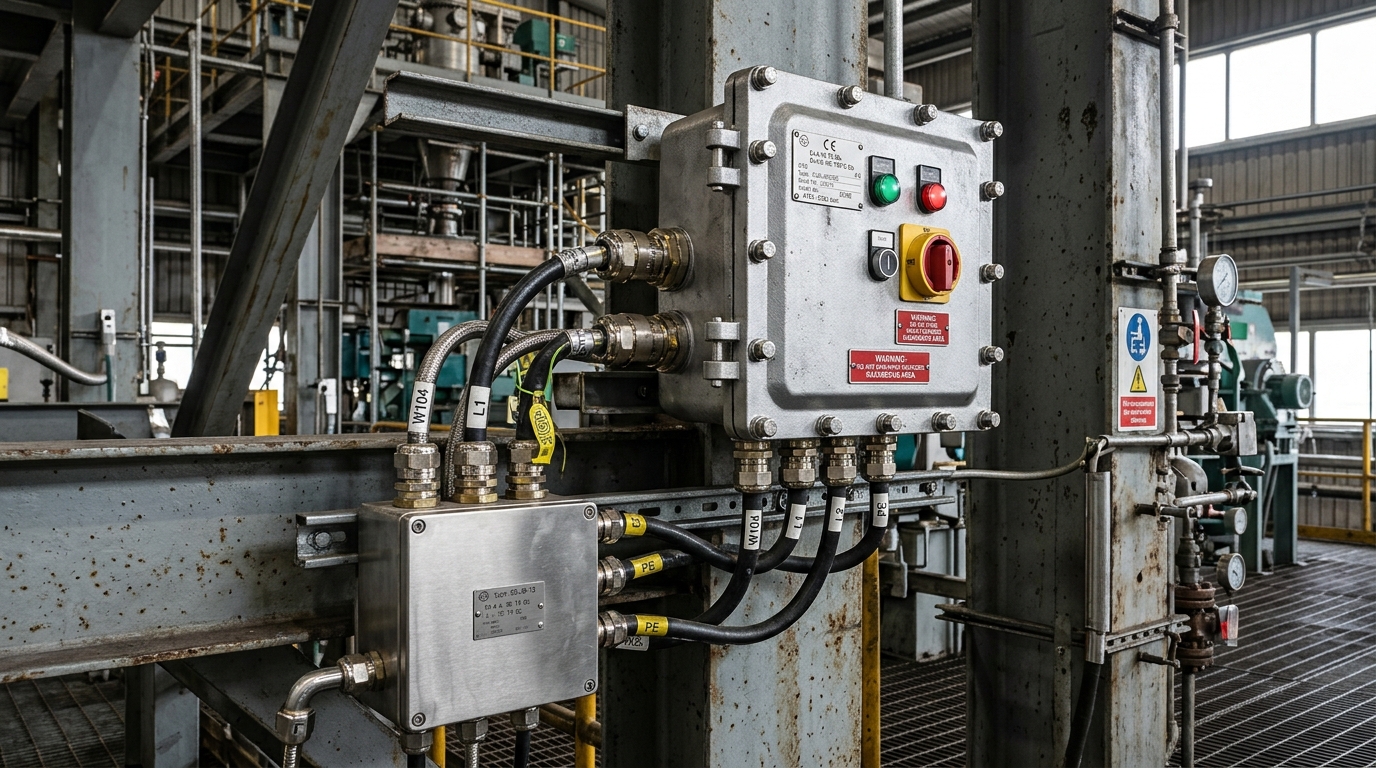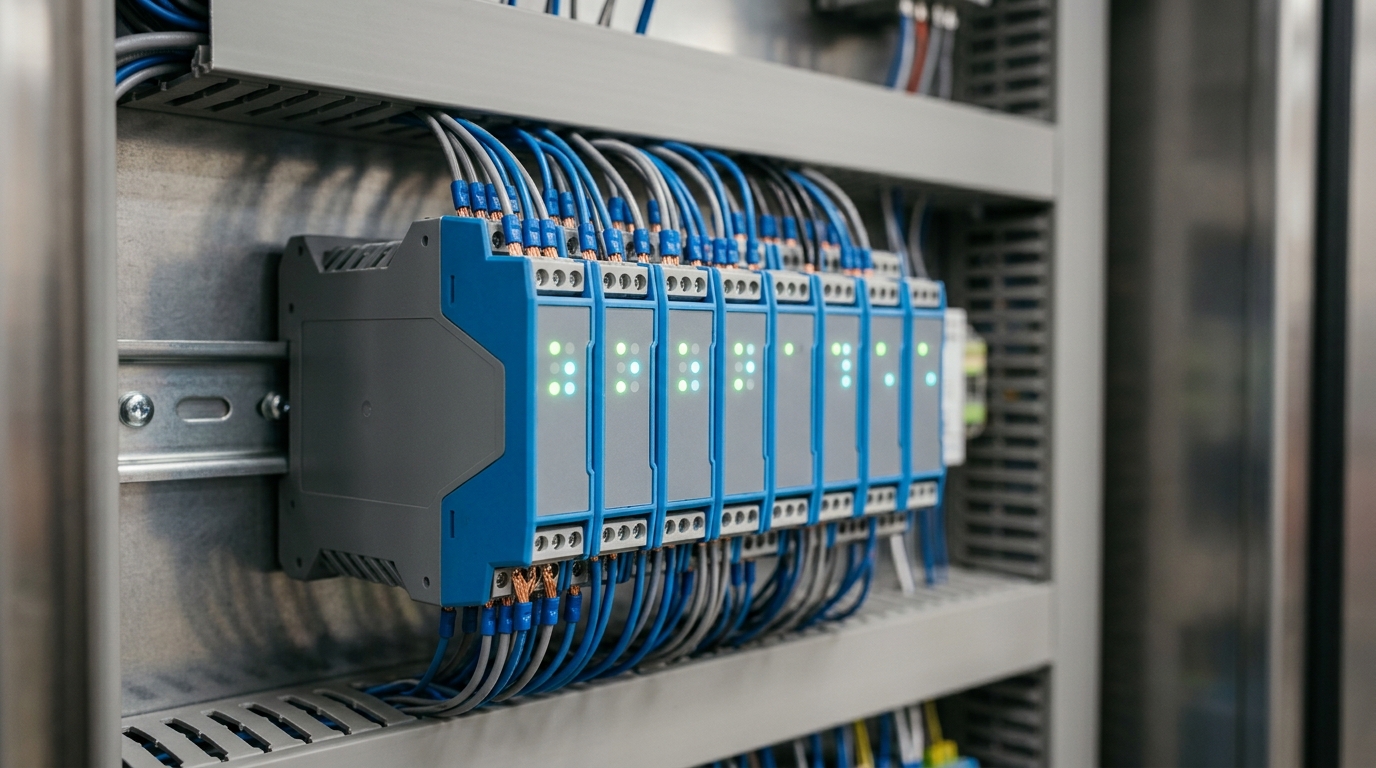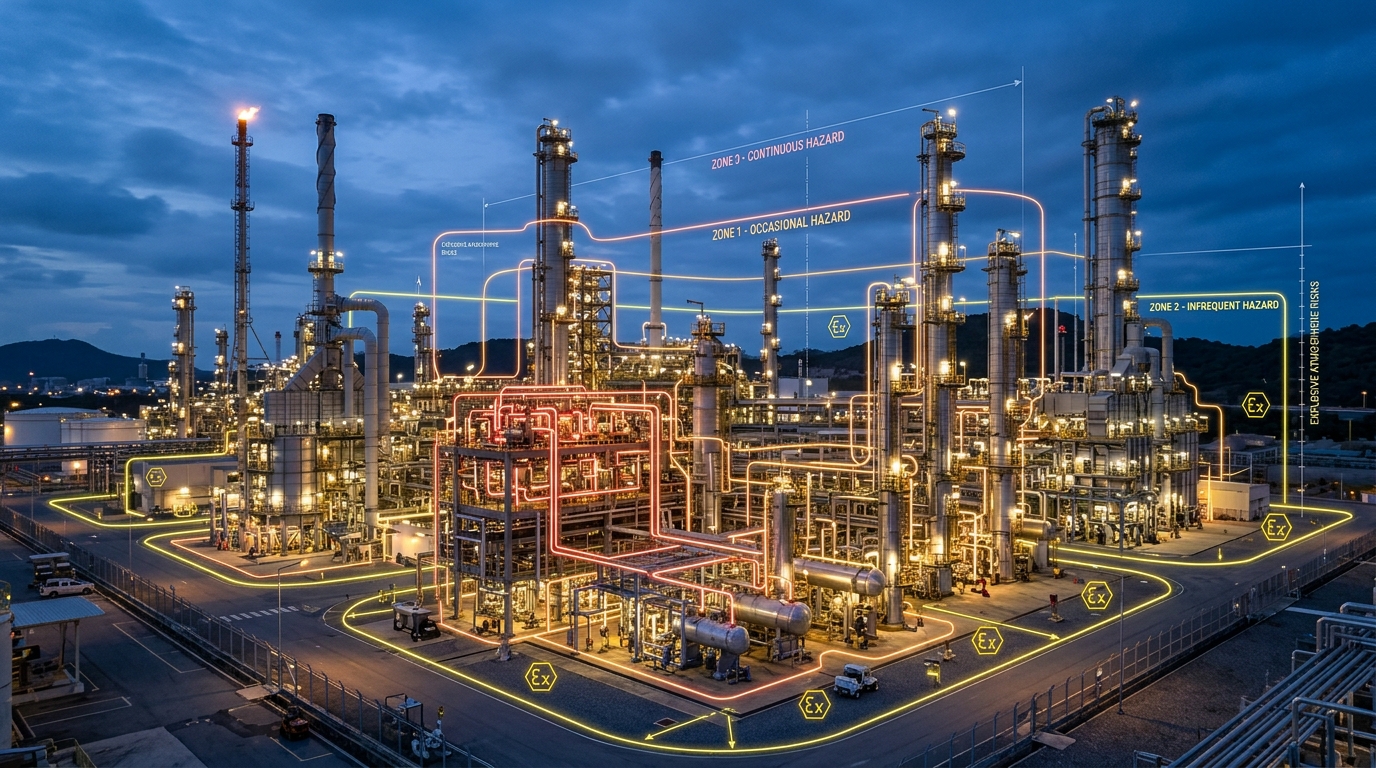
Hazardous Area Classification is the foundational engineering exercise performed before any electrical apparatus can be specified, purchased, or installed in an industrial facility handling flammable substances. Governed internationally by IEC 60079-10-1 (for explosive gases, vapours, and mists) and IEC 60079-10-2 (for combustible dusts), this process systematically maps the geographic risk zones, identifies the characteristic chemical behaviour of the fuels, and establishes strict thermal limitations.
1. The Three Release Grades & Zone Definitions
The classification process begins by identifying all potential sources of release—such as relief valves, pump mechanical seals, pipe flanges, and sampling taps—and categorizing them into three fundamental grades:
- Continuous Grade: Flammable release is present continuously or expected for long periods.
- Primary Grade: Release is likely to occur periodically during normal plant operation.
- Secondary Grade: Release is not expected in normal operation, and if it occurs, will exist only infrequently and for short durations.
Coupled with ventilation effectiveness calculations, these release grades define the classical operational zones:
| Zone (Gas) | Presence Frequency | Typical Operating Hours | Typical Industrial Locations |
|---|---|---|---|
| Zone 0 | Continuous or long duration | > 1,000 hrs/year | Inside fuel storage tanks, reactor interiors, vapor recovery lines |
| Zone 1 | Likely in normal operation | 10 to 1,000 hrs/year | Around pump seals, sampling points, relief valve discharge zones |
| Zone 2 | Unlikely; short duration if occurring | < 10 hrs/year | Pipe flanges, outdoor process units with natural air flow, tank farms |
2. Gas Groups: Understanding Chemical Volatility
Equipment certified for hazardous atmospheres in surface industries is classified under Group II, which is subdivided into three distinct gas groups based on their explosive ease of ignition and flame transmission speed:
- Group IIA (Least Sensitive): Representative gas: Propane (MESG > 0.9 mm; MIE > 180 µJ). Common gases: Methane, Butane, Diesel fuel vapour, Petrol vapours.
- Group IIB (Intermediate Sensitivity): Representative gas: Ethylene (0.5 mm ≤ MESG ≤ 0.9 mm; 60 µJ ≤ MIE ≤ 180 µJ). Common gases: Town gas, Ethyl ether, Cyclopropane.
- Group IIC (Most Sensitive & Severe): Representative gases: Hydrogen, Acetylene, and Carbon Disulphide (MESG < 0.5 mm; MIE < 60 µJ). Hydrogen has an extremely rapid flame velocity and requires ultra-tight flame path tolerances.
Engineering Rule of Thumb: Certification hierarchy is backward-compatible. Equipment certified for Group IIC is universally approved and certified for use in Group IIB and Group IIA atmospheres! Specifying Group IIC equipment simplifies plant stocking and eliminates misapplication risks.
3. Temperature Classes (T1 to T6): Surface Thermal Safety
Even without an electrical arc or spark, a flammable gas mixture can ignite if it comes into contact with a hot metal surface that exceeds its Auto-Ignition Temperature (AIT). Therefore, electrical apparatus must be rated for a maximum surface temperature under worst-case ambient operating conditions (typically up to +55°C in Pakistan’s industrial zones).
| Temperature Class | Max Surface Temperature | Permissible Gas AIT | Representative Flammables |
|---|---|---|---|
| T1 | 450 °C | > 450 °C | Methane (580°C), Hydrogen (560°C) |
| T2 | 300 °C | > 300 °C | Ethanol (365°C), Ethylene (425°C) |
| T3 | 200 °C | > 200 °C | Gasoline (280°C), Diesel fuel (220°C), Kerosene |
| T4 (Industry Standard) | 135 °C | > 135 °C | Diethyl Ether (160°C), Acetaldehyde (140°C). Covers 95% of refinery applications. |
| T5 | 100 °C | > 100 °C | Special chemical processes |
| T6 | 85 °C | > 85 °C | Carbon Disulphide (95°C) |
4. Decoding an ATEX & IECEx Certification String
When reviewing equipment nameplates, engineers must decode the standardized markings:
- II: Equipment Group II (Surface industries / Non-mining).
- 2: Equipment Category 2 (High protection level; safe for Zone 1 and Zone 2).
- G: Suitable for Gas, vapour, and mist atmospheres.
- Ex: Explosion-protected symbol.
- db: Flameproof enclosure (protection level “b” for Zone 1).
- eb: Increased safety terminal box (protection level “b” for Zone 1).
- IIC: Certified for the most severe gas group (Hydrogen/Acetylene).
- T4: Maximum surface temperature limited to ≤ 135 °C.
- Gb: Equipment Protection Level (EPL Gb = Zone 1 certified).
5. Partnering with Maple Pakistan
Navigating international explosion safety standards requires qualified hazardous area engineering expertise. Maple Pakistan (Pvt.) Ltd. works alongside engineering EPC contractors, refinery maintenance heads, and industrial safety officers across Pakistan to deliver:
- Hazardous area equipment audits and compliance verification.
- Photometric Dialux lighting studies utilizing ATEX/IECEx certified LED luminaires.
- Customized Ex de power distribution boards and motor control stations.
- Field technical support and commissioning from Karachi, Lahore, and Islamabad offices.